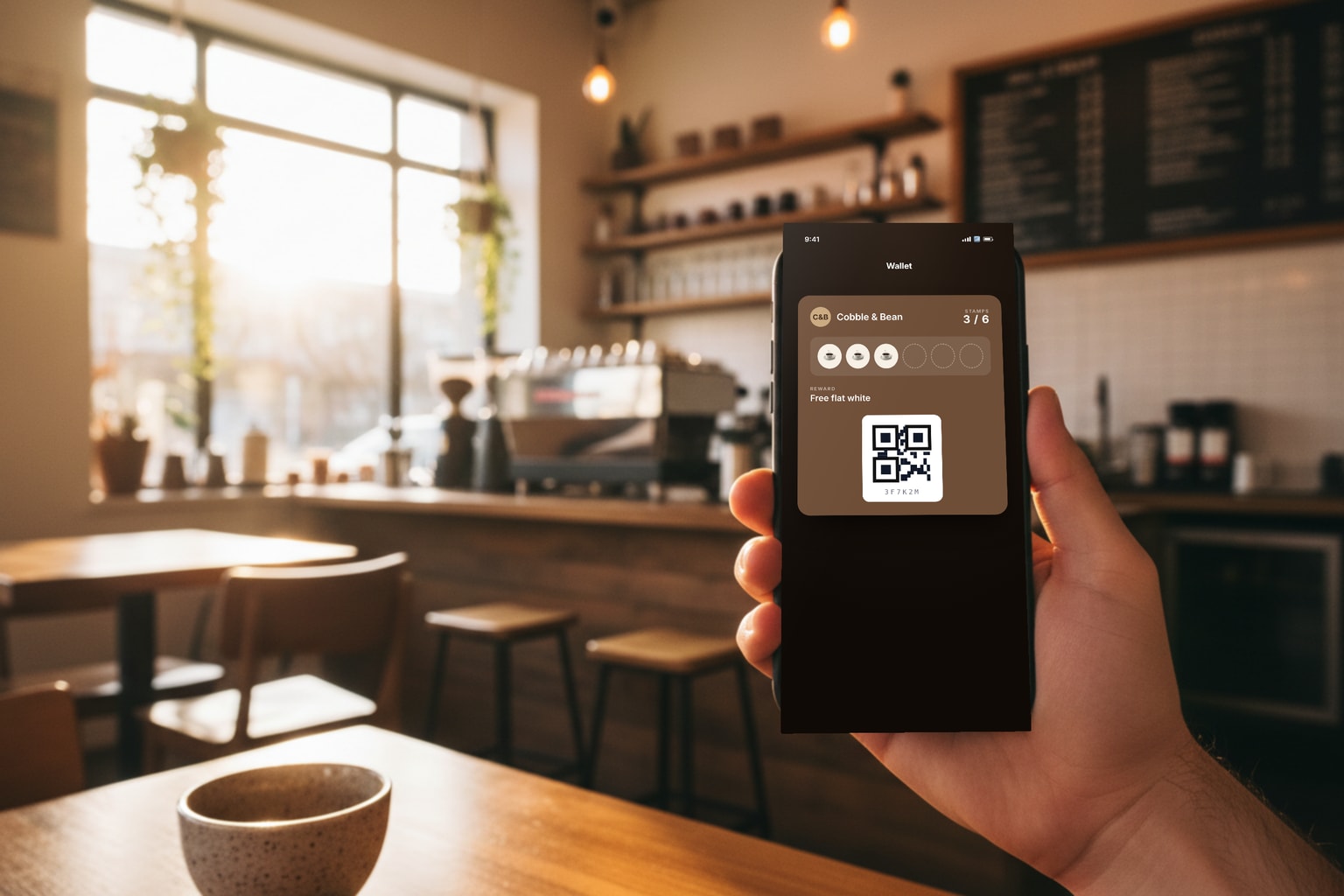
Stamps or points in Apple or Google Wallet — nothing to download, and their phone tells them when the card is full.
Paper loyalty cards die in the wash. The ones that survive live in a kitchen drawer, remembered the day after the visit. Every loyalty scheme lives or dies on the same thing — whether the card is there at the moment it's needed — and the phone always is. A loyalty card in Apple or Google Wallet can't be lost, can't be left at home, and sits in the same pocket as the way they pay.
Run it as stamps — six stamps and the seventh coffee is on the house — or as points against rewards you name yourself. The rules are yours: what earns a stamp, what the points add up to, what the reward is at the end. There's nothing for anyone to download and no app to install. The card drops into the wallet their phone already has, and the phone tells them when it's full. You never have to remind anyone they're one visit from a free coffee; their pocket does it.
Joining and stamping
People join by scanning the A4 poster we print for your counter. That's the entire sign-up: scan, and the card lands in their wallet. No app to hunt for, no account to create, no form longer than the queue they're standing in.
Stamping is kept just as plain. There's a PIN-protected counter link — open it on the till, a tablet or your own phone, and stamp the visit there. The PIN means only your staff can hand out stamps, so nobody is quietly topping up their own card while they wait for their order.
Quiet weeks
This is where the wallet card earns its keep. On a slow week, message the customers who are a stamp away — 'one more visit and the next one's on us' does more good than a discount shouted at strangers. You write it, and it goes only to people genuinely close to their reward, so it reads as a nudge rather than a broadcast.
Two rules, and they're firm ones. Only the people who ticked the box when they joined can be messaged at all. And nobody hears from you more than once every three days, however quiet the week. A card that pesters gets deleted, and a deleted card is worse than a paper one.
The honest edges
It lives in a smartphone wallet, so it needs a smartphone. A customer without one can't carry it, and there's no shame in keeping a few paper cards behind the counter for them.
The card doesn't pour the coffee. The reward is yours to honour, and the scheme only works if stamping becomes as routine at your counter as taking payment.
The message limit isn't a dial you can turn up. Once every three days at most, box-tickers only. We'd rather your card stayed welcome in their wallet than earn you one loud week.
It's built for the customers you already have. Bringing the same faces back is the whole job here; getting found by new ones is a different page of ours.
The idea is as old as the corner shop: reward the people who keep coming back, and they keep coming back. The only new part is that the card now lives where it can't be lost, counts itself, and tells its owner the moment the reward is ready.
We ask your customers for you, by text or email, in your words. Follow-ups chase as many times as you set, and stop when someone acts. We never screen anybody: there is no star question, so everyone sees the Google button, happy or not. Beside it, a private feedback button that comes straight to you, never published. They can also record a two-minute video testimonial, ticking the consent box themselves.
Replies are drafted in your voice: tone, length, sign-off. Approve each one, or let Autopilot answer Google reviews above a rating you choose, inside your working hours. It answers only reviews arriving after you switch it on, unless you ask it to work back through old ones. Trustpilot, TripAdvisor and Facebook can't be replied to automatically. We write the reply and take you to the review to paste it in.
A five-star review shouldn't sit on Google doing nothing. Turn one into a post, square, portrait or a story, in your colours with your logo. Send it to your Google Business Profile, Facebook, Instagram, LinkedIn or TikTok. The caption is written for you and you can change every word. It can also pick your best new five-star review and post it once a day, once every three days or weekly.
Six stamps and the seventh coffee is on the house, or points against rewards you name. The card sits in Apple or Google Wallet: nothing to download, their phone tells them when it's full. People join by scanning the A4 poster we print for your counter. On a quiet week, message the ones a stamp away: only those who ticked the box, never more than one message every three days.
Connect your Google Business Profile and the site builds itself from it: hours, photos, services, map and reviews, checked every hour. Change your Christmas hours on Google and the site follows within the hour. It's one long page, plus a journal written from your reviews, landing as drafts to read first. Nothing is live until you press publish, and nothing is shown to Google until you turn indexing on.
We plan topics around your Google categories, your town and the places you cover, then check them against what people actually search for. Each article is written from your own reviews, quoting customers as they wrote it, with its own picture. Posts land as drafts for you to read first. Choose every three days, weekly or fortnightly. If your blog is on WordPress, they publish straight there.