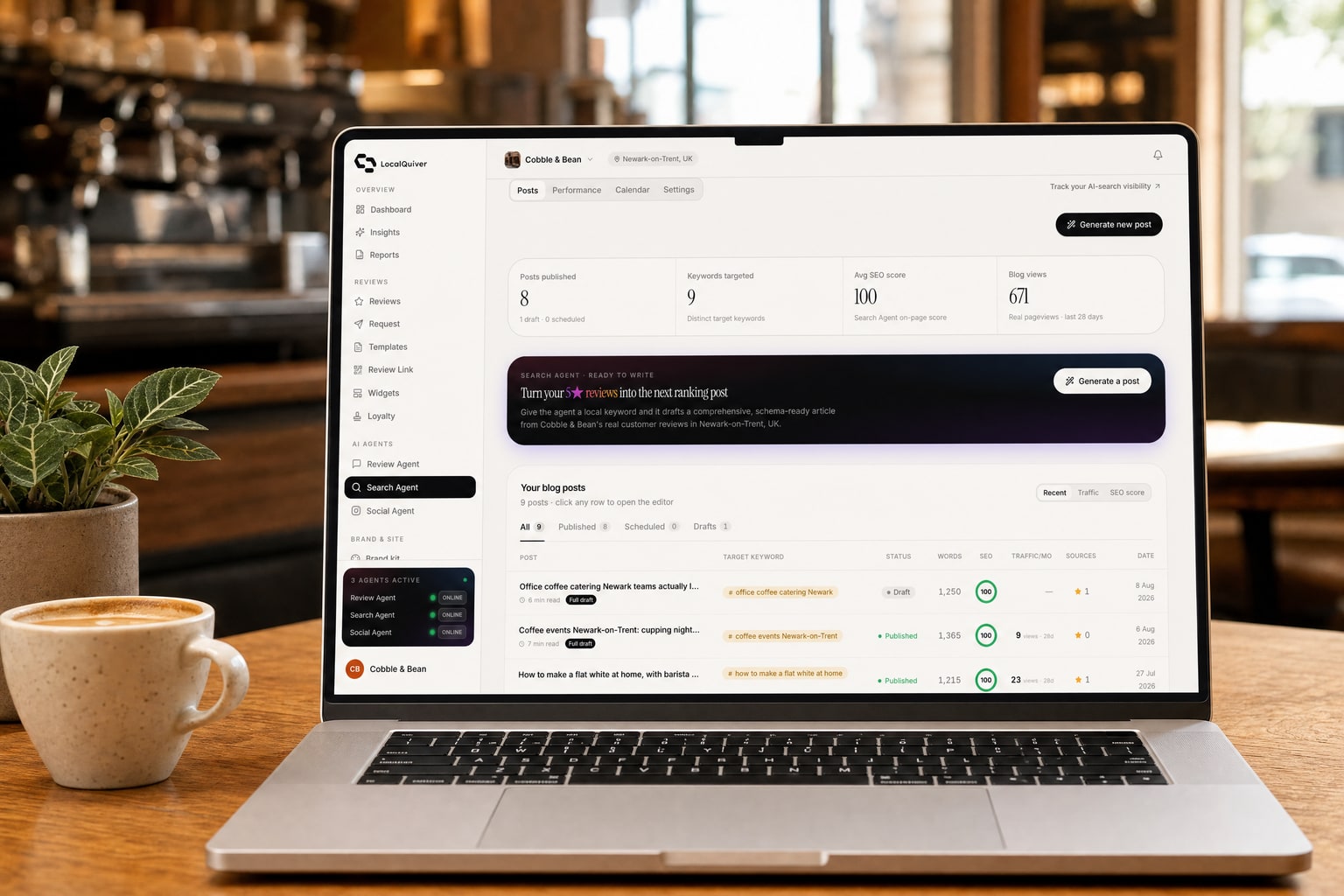
Articles planned around your categories, town and coverage area, written from your reviews — landing as drafts at the pace you choose.
Writing regularly about your own business is the job everyone means to get to and almost nobody does. Not from lack of caring — from lack of anything to say by Thursday. The journal takes both halves off your hands: deciding what to write about, and the writing itself.
Articles are planned around your Google categories, your town and the places you cover — in other words, around the things someone nearby would actually type into a search. Then they're written from your reviews, with customers quoted word for word, exactly as they wrote it. A real sentence from a real customer, odd comma and all, carries more weight than any polished line we could put in their mouth.
Where the words come from
The plan comes from what your business is. A plumber's journal is about the jobs plumbers do, in the places that plumber covers — not padding about the history of pipes. Your categories set the subjects, your town and coverage area set the ground, and your reviews supply the proof. One good review about an emergency call-out can carry a whole article about emergency call-outs, because that's exactly what a worried customer at midnight wants to know someone else survived.
The quoting is deliberate. Tidied-up quotes read like adverts; real ones read like evidence, so when an article leans on what a customer said, it uses their words, their phrasing, their spelling. And we'll say the quiet part plainly: nobody can honestly promise you a spot on page one, including us. What a journal like this does is give search engines something true to find about your trade and your town — which is more than most local websites give them.
Your rhythm, your finger on the button
Pick the pace that suits you: every three days, weekly or fortnightly. The planning and the writing keep to it without reminders from you — and for what it's worth, fortnightly and read beats daily and abandoned.
Every article lands as a draft, and a draft is all it is until you've read it and pressed publish. Nothing goes out with your name on it that you haven't seen. If one misses the mark, edit it or bin it; the schedule carries on regardless. It also means the journal can't embarrass you — a draft you haven't approved is invisible to everyone but you.
If your blog is on WordPress
Plenty of businesses already keep a blog, usually on WordPress, and the last thing anyone needs is a second one competing with it. So if your blog is on WordPress, the articles go there instead — same planning, same words, delivered into the blog you already run, on the site you already own.
Either way, the point is the same: a steady stream of pieces about your work, told in your customers' own words, on whichever site is yours.
One page with your Google button, logo and recent reviews, on a short link we host. Make a code per place: the counter, your invoices, one per van, and track each separately. A scan counts a tap on a review button: intent, not proof a review was left.
Google, Trustpilot, TripAdvisor and Facebook in one place. Google arrives every hour through an official connection to your Business Profile; the other three update daily. Filter by platform, stars or what still needs answering, and see the photos customers attached. Video testimonials and private feedback land there too.
Nine ways to show them: wall, carousel, spotlight, badge, floating bubble and more. One line of code, any website. Set a minimum rating, filter by keyword, or hand-pick them. Star-rating markup comes with it, so search engines read your rating. Any review you'd rather not show stays out.
A PIN-protected link for the counter: your Saturday team can stamp cards without touching your account. Any phone or tablet does it: no new hardware. Points are typed in or worked out from the spend. A mis-tap can be undone for fifteen minutes, and every stamp is logged.
Put your domain on the site when you're ready: we give you the DNS records, the certificate is automatic. Visitor figures are ours: how many came and what they looked at. No cookies, no IP addresses kept, no cookie banner. We can set up Google Search Console too.
Articles are planned around your Google categories, your town and the places you cover, then written from your reviews, quoted as the customer wrote them. Every three days, weekly or fortnightly, whichever you pick. Posts land as drafts. If your blog is on WordPress, they publish there instead.