Get found
Where you appear on Google Maps depends on where the customer is standing. Rank tracking runs your key search from a grid of points around your business once a month, then shows where you appear, who beats you, and two or three plain-English things to do next.
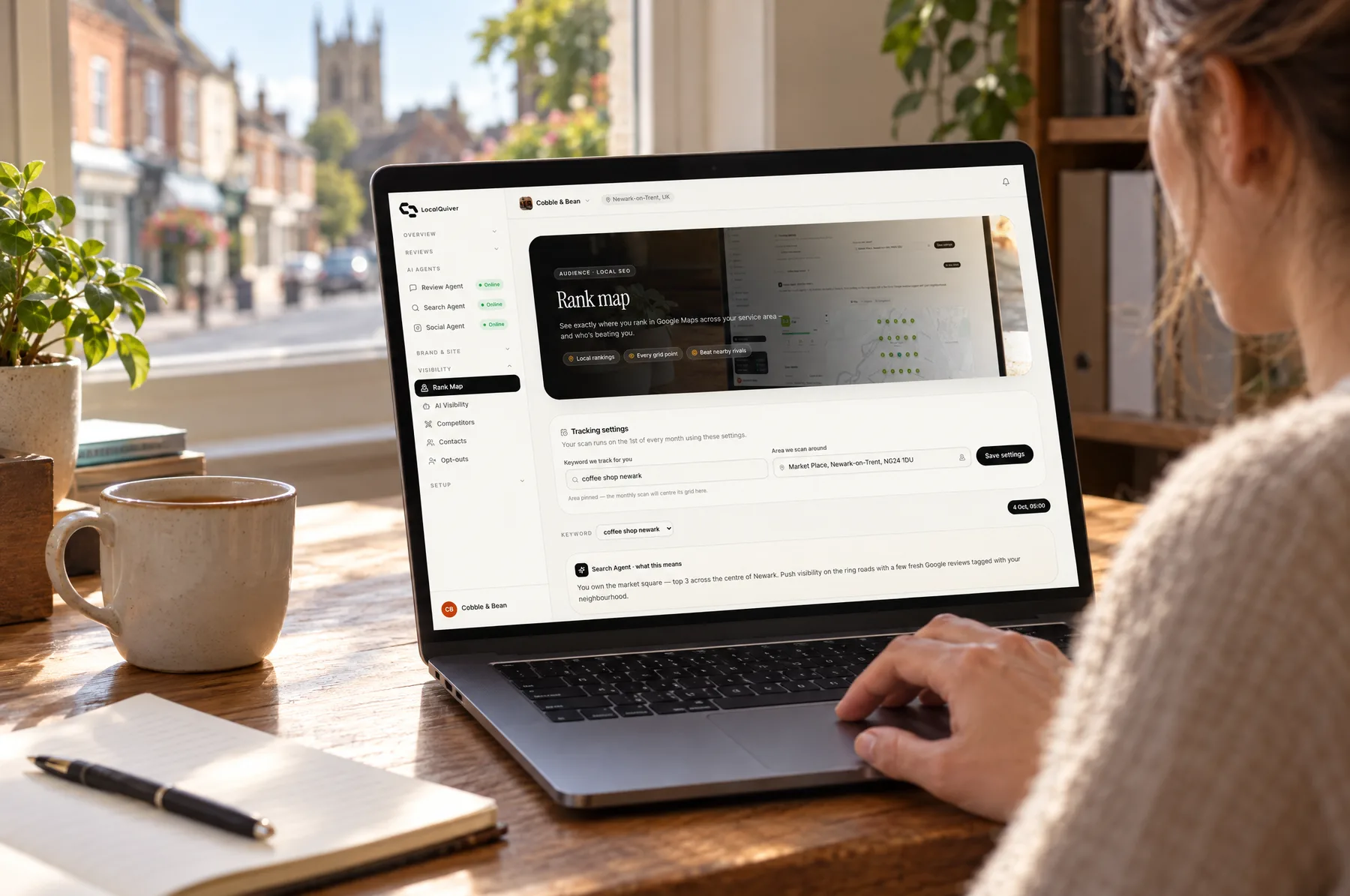
You own the market square: top 3 across the centre of Newark. A few fresh reviews will push you out to the ring roads.
What changes
Know where you’re missing out
See the parts of your area where you show near the top, and the places you don’t appear at all, so you know exactly where new customers are finding someone else instead of you.
See who’s beating you
At every point on the map you can see who outranks you, plus a table of your top competitors across the whole area, so you know exactly who you’re up against, and where.
Progress you can actually see
Every monthly scan is kept, with a trend against last month, so you can tell whether the work on reviews, your Google profile and your articles is moving you in the right direction.
The film
Three self-contained chapters: a monthly Google Maps scan from a grid of points around the business, a monthly check of whether ChatGPT, Gemini and Perplexity name it, and a monthly head-to-head with the local rivals it picks.
Read the transcript
0:01Where you show up on Google Maps depends on where your customer is standing.
0:06So once a month, we run your key search from a grid of points around your business, as if a customer were standing at each one.
0:13You see where you're top three, where you don't appear at all, who beats you at each point, and two or three plain-English things to do next.
0:24Customers can now ask AI assistants where to go, too.
0:28Once a month, we put up to four of your customers' questions to ChatGPT, Gemini and Perplexity, each answering from live web results.
0:37You see whether you're named, how high, and who's named instead. Nobody can buy a recommendation, but now you'll know where you stand.
0:48And how do you stack up against your local rivals?
0:52Pick them from Google, and every month we check their rating and review count, new reviews, how often they reply, what customers praise and complain about, their AI visibility and map position.
1:04Then it's all set beside yours, head to head, so you can see where you're ahead, and where they're pulling away.
1:12LocalQuiver. Your marketing, sorted.
Open “See where you stand: rank, AI and competitors” on its own page →Browse all our films →
How it works
- 01Choose the searchWe agree the one search phrase that matters most to you, like ‘emergency plumber’ or ‘coffee shop near me’, and set the grid around your business.
- 02Scan the gridOn the 1st of every month, that search runs from each point on the grid, 25 by default and a kilometre apart, as if a customer were standing there.
- 03Read the mapEach point gets a pin coloured by your position, with your average and best position, how many points are top three or top ten, and the gaps.
- 04Act on itA short plain-English read suggests two or three things to do next, and the trend against last month shows what moved.
What's included
- A grid of points around your business, 5×5 by default
- Grid size and spacing set to fit your area
- One key search phrase, rescanned on the 1st of each month
- A pin at every point, coloured by your position
- Your average and best position, plus a visibility score
- How many points you’re top three or top ten
- Where you don’t appear at all
- Who outranks you at each point, and a top-competitor table
- A trend against last month, with past scans kept
- Two or three plain-English things to do next
By industry
The same feature works differently for a pub than a plumber. See how it works for yours.
Once a month, on the 1st. The same search runs from every point on your grid, and each scan is kept so you can compare one month with the next. It isn’t live or daily tracking, and the scan runs on our schedule rather than on demand.
The map follows one search phrase, the one that matters most to your business, so the trend stays meaningful from month to month. We help you choose it, whether that’s ‘emergency electrician’, ‘sunday roast near me’ or ‘MOT centre’.
Not on its own. It measures; it doesn’t act. What it gives you is a clear picture of where you show up and who beats you, so the work that does help, like more reviews, a complete Google profile and regular articles, goes where it counts.
By default it’s a 5×5 grid of 25 points, a kilometre apart, centred on your business. We can set a smaller 3×3 or larger 7×7 grid, with points from half a kilometre to two kilometres apart, to match how far your customers usually travel.
Google Maps results depend on where the person searching is standing. Searching from your own premises can make you look better placed than you are a couple of kilometres away. The grid shows what people across your area see, not just what you see at your own door.
Book a free, no-pressure chat and we'll show you how Google Maps rank tracking would work for your business, set up and running for you.